A small room does not always need less. Sometimes it needs fewer wrong things. That is the part most decorating advice skips. A tiny bedroom can feel cramped even with pale walls. A small living room can still look busy after you remove half the decor. The room usually feels small because the furniture scale is off, the floor is broken up, the light is flat, or there is no clear place for the eye to rest.
If you are trying to decide whether to repaint, rearrange furniture or replace a bulky piece, an AI room design tool can help test layouts, wall colours and furniture scale before you start buying. That matters in a small room because every change is more visible.
Here is how to make a small room look bigger without turning it into a blank white box.
Start with what makes the room feel small
Before changing paint or ordering new furniture, work out why the room feels tight. Small rooms usually have one main problem, even when it looks like everything is the problem.
Sometimes the furniture blocks movement. A chair sticks out into the walkway. A bed sits too close to the wardrobe. A coffee table leaves no room to walk around the sofa. In that case, the room needs a better layout, not more decor.
Sometimes the room has too many visual breaks. A small rug, dark curtains, exposed storage bins, open shelving and several accent colours can chop the space into pieces. The eye never gets a clean line across the room, so the room feels smaller than it is.
Light is another common issue. One ceiling fixture can make corners feel dull and low. A small room needs layered light because shadows shrink the edges. A lamp near a chair, a wall sconce beside a bed or a soft uplight in a dark corner can make the room feel more open without changing its size.
Once you know the real problem, the fix becomes less random.
A quick small-room decision table
Use this as a filter before making changes. It keeps the project from turning into a pile of unrelated decorating ideas.
| What makes the room feel small | Better design move | Avoid |
|---|---|---|
| Too much furniture | One larger anchor piece with fewer extras | Several tiny accent pieces |
| Dark corners | Two or three soft light sources | One overhead light only |
| Cluttered floor | Raised furniture and closed storage | Baskets on every open surface |
| Low ceiling | Curtains hung closer to the ceiling | Short curtains mounted at window height |
| No clear focal point | One visual anchor, such as art, bed or sofa | Decor scattered across every wall |
| Awkward layout | Test furniture placement before buying | Buying by guesswork |
The goal is not to make the room look bigger at any cost. The goal is to make it feel easier to use.
Use furniture scale, not just smaller furniture
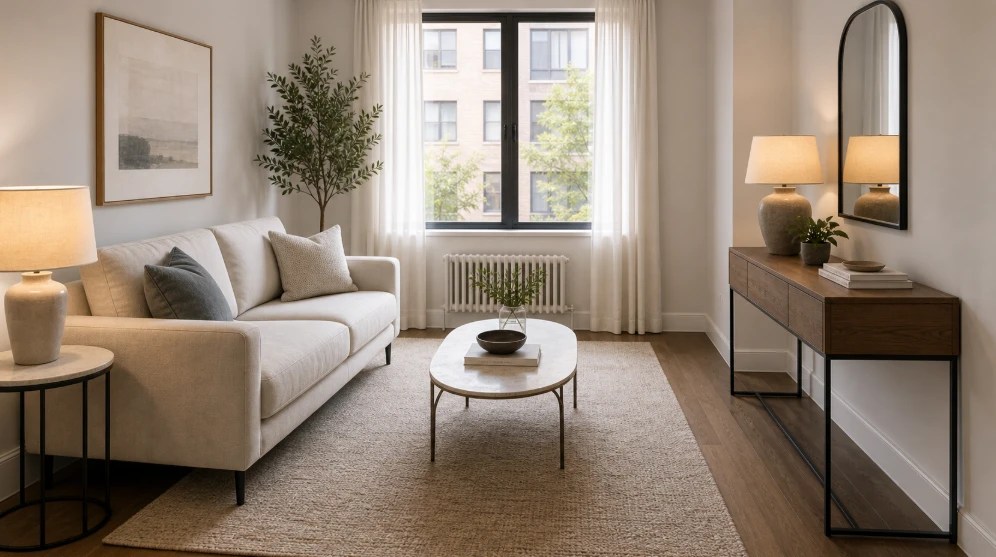
The usual advice is to buy small furniture for a small room. That sounds logical, but it often creates the opposite effect. Too many tiny pieces make a room feel nervous. A narrow table here, a little shelf there, a compact chair in the corner, a small storage cart beside the door. The room may technically have more floor space, but it looks cluttered.
A better approach is to choose one properly scaled anchor piece and reduce the supporting pieces. In a bedroom, that might mean a real bed with slim nightstands instead of a bed squeezed between random storage. In a living room, it might mean a comfortable sofa with legs instead of a loveseat, two chairs, three side tables and a storage ottoman fighting for space.
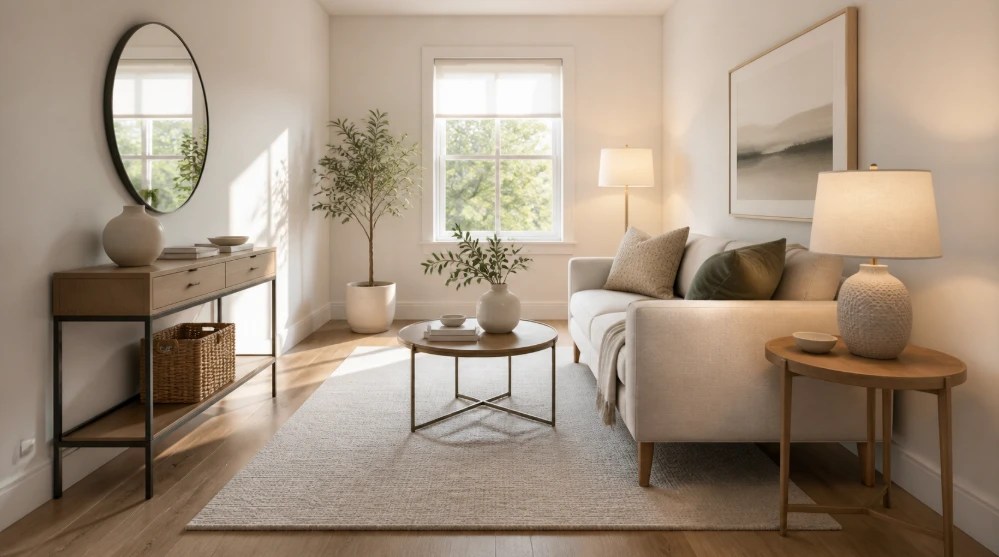
Raised furniture helps because the eye can see more floor underneath it. Sofas, beds, consoles and chairs with visible legs usually feel lighter than blocky pieces that sit directly on the floor. This does not mean every piece needs skinny legs. It means the room needs some breathing room at floor level.
Be careful with oversized furniture, though. A large piece can work beautifully if it fits the wall and leaves a clear walking path. It fails when it blocks doors, windows or storage. In a small room, function is part of scale.
Make the floor look more open
Visible floor is one of the fastest ways to make a room feel larger. The floor is the room’s negative space. When it is covered with furniture legs, baskets, boxes, cords and small rugs, the room feels crowded even if the walls are pale.
Start by clearing the walking path. In a bedroom, the route from the door to the bed and wardrobe should feel obvious. In a living room, the path between the sofa, entry and window should not require side-stepping around furniture. If the path feels awkward, the room will feel small.
Rugs matter here. A rug that is too small can make furniture look disconnected and shrink the room visually. In a small living room, the front legs of the sofa and main chair should usually sit on the rug if space allows. In a bedroom, a rug should extend beyond the sides of the bed enough to feel intentional. Tiny rugs floating in the middle of the floor rarely help.
Use fewer floor accessories. A basket can be useful. Five baskets read as clutter, even if they are pretty. The same goes for plant stands, stools, poufs and decorative ladders. In a small room, every object that touches the floor has to earn its place.
Choose wall colours that add softness and light
White can make a small room look bigger, but it is not the only answer. It is also not always the best one. A cold white in a room with little natural light can feel flat and grey. A warmer off-white, soft beige, pale mushroom, muted blush, light sage or gentle greige can make the room feel brighter without feeling sterile.
The trick is to reduce contrast where the room is already choppy. If the walls, trim, door and ceiling are all strongly different colours, the eye notices every edge. Painting trim close to the wall colour can soften the room. Using a similar tone on built-ins can make storage feel less bulky.
Dark colours are not forbidden. A small powder room, reading nook or bedroom can look lovely in a deep colour. But if the goal is specifically to make a small room look bigger, dark paint needs help from good lighting, fewer objects and a clear focal point. Otherwise it can close the room in.
Test paint in the room before committing. Morning light, evening light and artificial light can change the colour more than a paint card suggests.
Use mirrors without making the room feel obvious
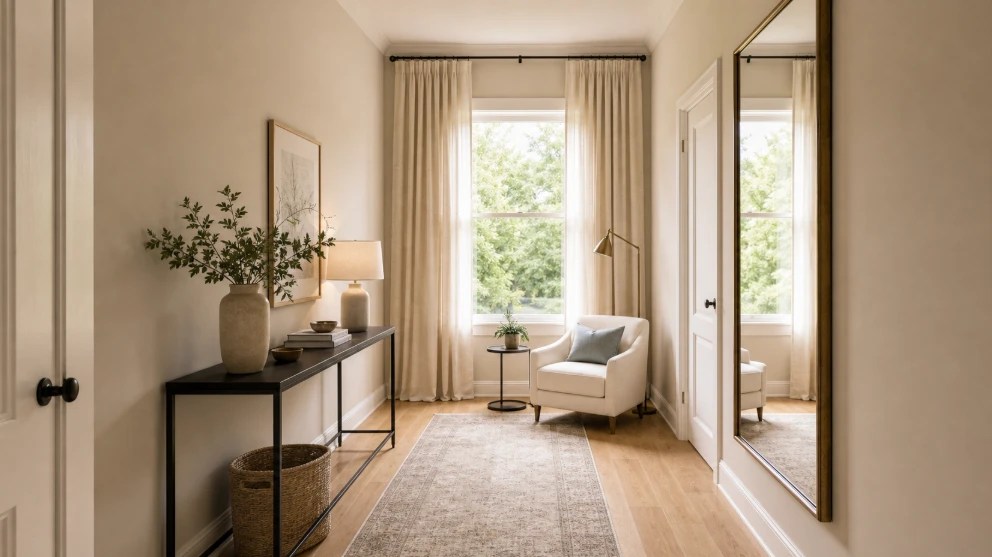
Mirrors can make a small room feel bigger, but only when they reflect something worth seeing. A mirror facing a window can bounce light. A mirror near a lamp can double the glow at night. A mirror above a console can give a narrow room more depth.
A mirror that reflects clutter, a blank wall or an awkward corner will not do much. It may even make the room feel busier.
Scale matters here too. One well-placed mirror usually works better than several small mirrors scattered around the room. In a bedroom, a full-length mirror can be practical and visually useful if it has a clean reflection. In a living room, a large mirror above a sofa or console can act like a window if the frame is simple.
Do not force a mirror into every small space. Art, a tall curtain line or a good lamp can sometimes do more.
Fix the lighting before buying more decor
Small rooms often look smaller at night because the lighting is too harsh or too flat. One ceiling light creates shadows in corners and makes the room feel lower. More decor will not fix that.
A good small room usually has light at different heights. A table lamp near the sofa, a floor lamp in a dark corner, a sconce beside the bed or a small picture light over art can change the whole room. The effect is subtle, but it matters. Soft light pushes the edges outward.
Warm bulbs usually feel better in bedrooms and living spaces than cold white bulbs. If the room is used for work, use a task lamp where you need focus rather than making the whole room bright and clinical.
Think about what the room looks like in the evening, not only in daylight. A small room that feels cosy at night can feel bigger because it has depth instead of one flat pool of light.
Storage ideas that make a small room look bigger

Storage helps only when it reduces visual noise. Open shelves can be beautiful, but in a small room they need editing. If every shelf is packed with books, boxes, candles, frames and random objects, the storage becomes the clutter.
Closed storage is often better for small rooms. A bed with drawers, a slim cabinet, a storage bench or a wardrobe with clean doors can hide the everyday things that make a room feel crowded. The outside should look calm even if the inside is doing real work.
Before buying storage, sort the problem into three groups:
- Things you use daily and need within reach.
- Things you use weekly but do not need visible.
- Things that belong somewhere else entirely.
That last group is the quiet killer. Small rooms often become holding zones for items that do not have a home. No shelf or basket will make that look spacious.
Small bedroom tricks that actually work
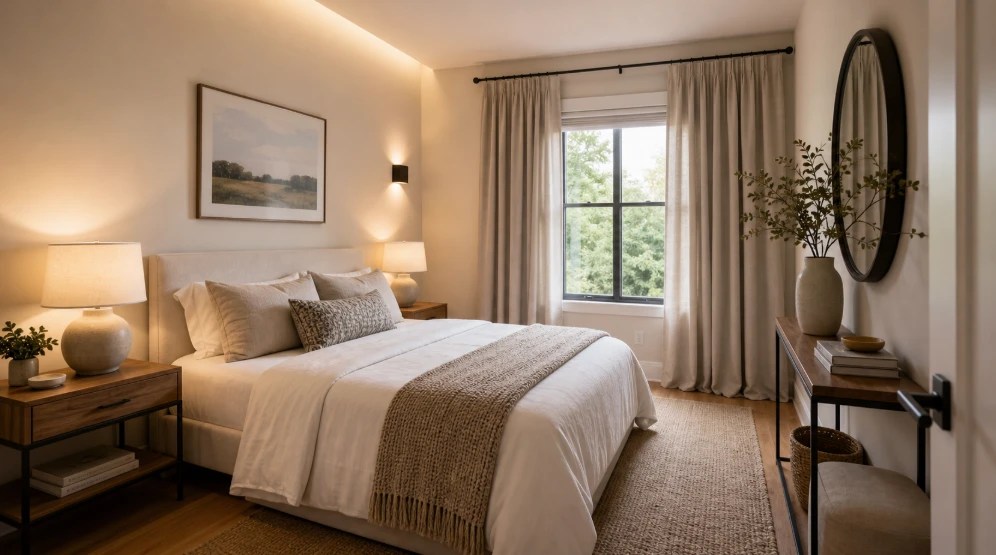
To make a small bedroom look bigger, start with the bed wall. The bed is usually the largest object in the room, so it should look intentional. A headboard, two slim nightstands or matching wall lamps can make the bed feel like the centre of the room rather than something squeezed into a corner.
If the room has low ceilings, hang curtains higher than the window frame. Letting the curtain line rise closer to the ceiling makes the wall look taller. Choose fabric that falls cleanly rather than bunching heavily on the floor.
Keep the bedside area simple. A lamp, a book and one small tray can look calm. A pile of chargers, bottles, jewellery, receipts and decor makes the whole room feel smaller. If you need storage, use a nightstand with a drawer rather than an open table.
For colour, bedrooms can handle softness. Warm white, pale taupe, light olive, dusty blue and muted pink can make a small bedroom feel bigger while still feeling personal. Pure white is fine if the room has good light and texture. Without texture, it can look unfinished.
Small living room tricks that actually work
Small living rooms need a clear seating plan. The sofa should face the main purpose of the room, whether that is a TV, fireplace, window or conversation area. When the room has no obvious focal point, furniture starts drifting toward the walls and the middle becomes awkward.
Floating furniture slightly away from the wall can sometimes make the room feel bigger, even though it uses more space. This works when it creates a clearer path behind or around the seating. It does not work if the room is too narrow.
Choose tables carefully. A glass table is not automatically better, and a tiny coffee table can look silly in front of a real sofa. A slim oval table, nesting tables or a small upholstered ottoman can work depending on how the room is used.
In a small living room, repeat colours instead of adding new ones. If the rug has warm beige and black, bring those tones into pillows, frames or a lamp. Repetition makes the room feel calmer. Too many one-off colours make it feel smaller.
Mistakes that make a small room feel smaller
Some choices shrink a room even when they are popular online.
- Pushing every piece of furniture against the wall without checking the walking path.
- Using several tiny rugs instead of one rug that connects the furniture.
- Adding open shelves before reducing clutter.
- Choosing curtains that stop exactly at the window frame.
- Using only one ceiling light.
- Buying furniture before measuring door swings, outlets and walkways.
None of these mistakes are dramatic on their own. Together, they make a small room feel harder to live in.
FAQ
What colour makes a small room look bigger?
Soft light colours usually make a small room look bigger, especially warm white, off-white, pale beige, light greige, soft sage and muted blush. The best colour depends on the room’s light. A cold white can look grey in a dark room, while a warm neutral can feel brighter and softer.
Do mirrors really make a small room look bigger?
Mirrors can make a small room look bigger when they reflect light, a window, art or a clean view across the room. They do not help much if they reflect clutter or a blank wall. One larger mirror placed well usually works better than several small mirrors.
Should small rooms have small furniture?
Not always. A small room usually looks better with fewer, better-scaled pieces than with many tiny pieces. One real sofa can look calmer than a loveseat, two small chairs and several little tables. The furniture should leave a clear walking path and some visible floor.
How can I make a small bedroom look bigger?
Use the bed wall as the focal point, keep nightstands slim, hang curtains higher, use soft wall colours and reduce clutter around the bed. A rug that extends beyond the bed can also make the room feel more finished and less cramped.
How can I make a small living room look bigger?
Create one clear seating plan, use a rug that connects the furniture, add lighting at different heights and avoid too many small accent pieces. Repeating a few colours across the room can make the space feel calmer and visually larger.
Making a small room look bigger is less about tricks and more about editing the room’s signals. The eye wants a clear path, a calm focal point, enough light and furniture that makes sense for the space.
Start with layout. Then fix the floor, lighting and storage. After that, colour and decor become much easier to choose.
Please Note: I always strive to provide accurate and helpful information, but just a quick heads-up—I’m a blogger, not a doctor, lawyer, CPA, or any other kind of certified professional. I’m here to share my experiences and insights, but please make sure to use your own judgment and consult the right professionals when needed.
Also, I accept monetary compensation through affiliate links, advertising, guest posts, and sponsored partnerships on this site, however I am very particular about the products I endorse and only do so when I am truly a fan of the quality and result of the product.